
Cibola County Projected Release Dates
A projected release date is a sentence-computation estimate based on the judgment, credited time, applicable deduction rules, and later events known to the custodian. An actual release date records the completed custody event. They can differ. A discipline decision can forfeit deductions. An amended judgment can change the term. A detainer can cause another agency to take custody. Parole can end prison confinement while supervision continues. The actual discharge or release entry is therefore the final record of the event, not the early estimate.
Pretrial detention is different. A person held on an unresolved Cibola County case does not have a sentence-based projected date. The court may change conditions, order release, dismiss a matter, or later impose a sentence. CCCC then checks identity, warrants, holds, and any receiving authority before the person leaves. The docket can establish legal authority, but the jail release log supplies the physical exit or transfer time.
Find a Cibola County Release Date
Start by separating county, state, federal, and immigration custody. CCCC has historically housed more than one authority in the same building. A county booking belongs with county and court records. A person transferred after sentence to one of the Western New Mexico Correctional Facility campuses belongs in NMCD's system. USMS, BOP, and ICE each require their own federal route. The physical address does not decide which office computes the date.
- Identify the current legal custodian. Call CCCC intake at 505-285-4979 if the person may be held at the Milan facility, and ask which agency owns custody.
- Obtain the signed judgment and sentence, any amended judgment, and the record of presentence confinement credit from the court.
- For an NMCD prisoner, use the official search with the correct status choice, then request the time-computation record from Offender Management Services.
- For a county sentence, request the jail's calculation and the court commitment. Do not apply state-prison deduction rates.
- Ask for the projected or mandatory release date, revision history, earned and forfeited deduction ledger, and actual release or discharge entry.
- Check whether parole, probation, a warrant, or another agency hold follows the physical release date.
The Cibola County released-inmate search covers the wider custody trail when it is unclear where the person went. For date computation, however, the signed judgment and the calculating agency's ledger are central. A third-party calculator cannot know every amendment, presentence credit entry, forfeiture, or hold.
Cibola County NMCD Date Search
The NMCD Offender Search application accepts last name, first name, offender number, and age limits. “Active” is the default. Use “Include Inactive” when researching historical state custody. The form also has an “Absconder Only” mode with regional choices, but that serves supervision and warrant research rather than sentence calculation. Complete the CAPTCHA and compare identifiers closely.
The captured NMCD form documents those verified search fields.
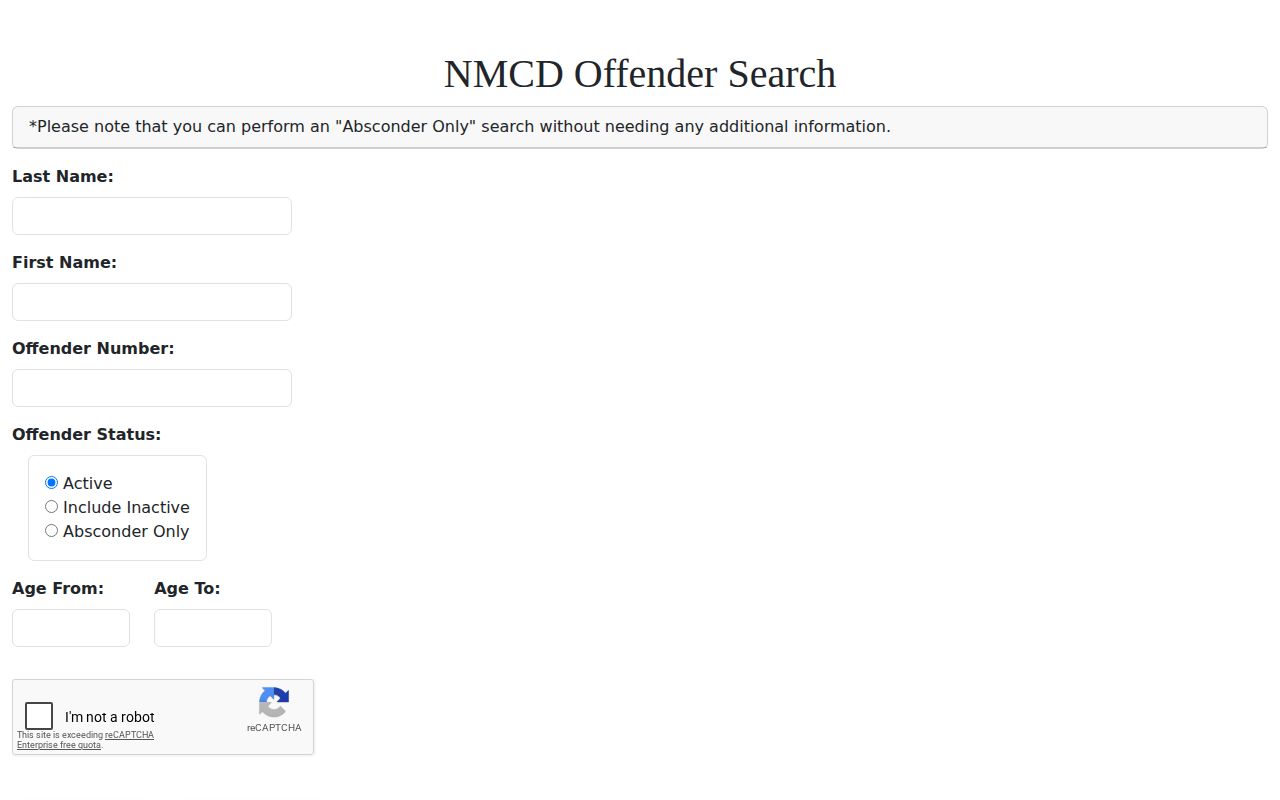
A CAPTCHA prevented review of a lawful live inactive result during research. The exact result label, projected-date field, actual release-date field, and photo behavior could not be confirmed. Do not tell a reader to look for a field that may not be displayed. Record only what the human-run result actually shows. If the public result does not supply the date, use NMCD records.
NMCD states that adult-prison data update nightly, probation and parole information updates in real time, and some prison information may require 24 hours. It also tells users to verify location and legal status with the institution or supervision office because people move. The public form is a locator. It is not a certified sentence computation.
Note: A public NMCD result can guide the request, but OMS holds the official state-prison sentence computation.
Cibola County NMCD Computation Record
NMCD Offender Management Services determines state-prison release dates from judgments and sentences, records earned and forfeited credit, and tracks a prisoner from intake through release. Its computation file can show why a date moved. Ask for judgment-and-sentence information, admission and presentence-credit entries, the time-computation sheet, projected or mandatory date and revision history, and the deduction ledger. Also request the actual release or discharge entry, parole certificate or status, and last institution when relevant.
The NMCD NextRequest portal is the current written records route. The manifest capture shows the official request channel.
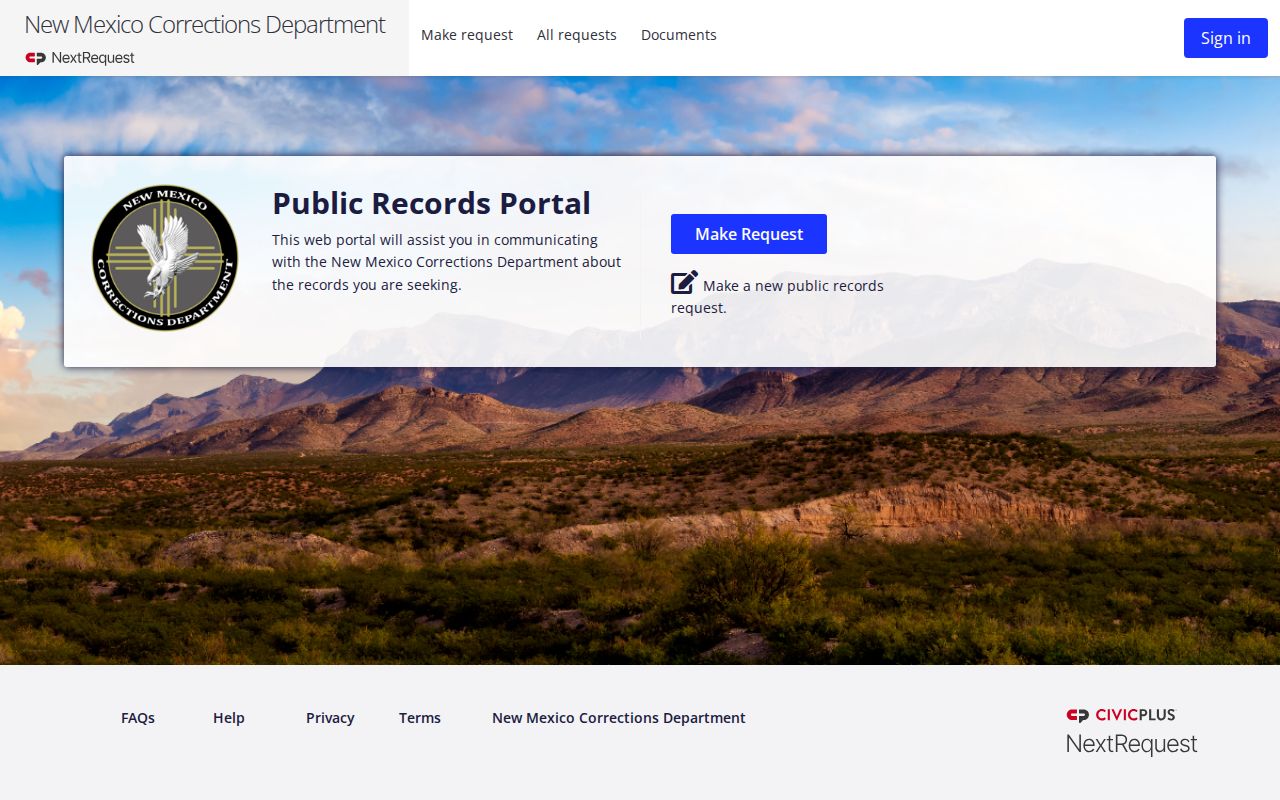
The records request should be narrow enough to identify the prisoner and computation sought. A revision history is often as important as the latest date because it ties changes to credit, discipline, judgment, or parole-plan events. Request releasable nonexempt portions if part of the file must be withheld. The result is a documented calculation, not a date guessed from the sentence length.
Cibola County State Release Credits
New Mexico's earned meritorious deduction statute, NMSA 1978 §33-2-34, applies after presentence confinement is credited. The maximum rate stated in the research is four days per month for a statutory serious violent offense and 30 days per month for a nonviolent offense. The serious-violent category includes listed crimes and some offenses designated by a judge based on their nature and harm. The actual classification must come from the judgment and governing law.
Credits are awards, not automatic promises. Participation, staff recommendation and approval, disciplinary status, forfeiture, presentence credit, concurrent or consecutive structure, later judgment changes, offense class, and parole-plan status can affect the projection. Approved programs or education can support lump awards within statutory limits. Ordinary deductions do not turn life or life-without-parole into a standard fixed term.
- Presentence credit
- Time the judgment credits for confinement before sentence.
- Earned deduction
- An approved reduction under the governing statute and agency record.
- Forfeiture
- Loss of credited time after a qualifying discipline or statutory event.
- Consecutive terms
- Terms served one after another, unlike concurrent terms served at the same time.
Parole eligibility is not the same as a projected prison release date, and mandatory parole may follow the incarceration portion. A parole plan can affect when the physical exit occurs. The signed judgment, OMS ledger, and Board or supervision record must be read together when parole applies.
Cibola County 85 Percent Claim
The often-repeated claim that a New Mexico prisoner must serve 85 percent is only an approximation for one capped category. Four deduction days per month is about 48 credit days in a year, leaving roughly 86.8 percent of calendar time before other effects. “Roughly 85 percent” is shorthand for that serious-violent maximum, not a blanket state rule. A nonviolent offense can have a different maximum deduction rate.
Do not multiply every sentence by 0.85. That shortcut ignores presentence credit, the offense's legal category, consecutive or concurrent terms, earned and forfeited deductions, amendments, parole requirements, and holds. It can also misstate a county-jail sentence, which is governed by a separate law and local calculation. OMS applies the actual judgment and ledger to state prisoners.
The offense date and statutory version may matter. Special parole provisions can also apply to certain offenses. A statute summary helps locate the rule, but it does not replace review of the judgment or a computation from the agency responsible for the person. Ask for the record rather than promising an estimate.
Note: The 85 percent phrase is not a universal New Mexico release formula and must not be applied mechanically to a Cibola County case.
Cibola County Jail Good Time
County sentences follow a separate framework. NMSA 1978 §33-3-9 permits a sheriff or jail administrator to establish rules or grant deductions for good behavior with approval from the committing judge. No current Cibola County accrual schedule was found. That absence means the NMCD four-day and 30-day rates cannot be copied onto a county term.
Obtain the local jail calculation, the court commitment, and any order addressing credit. Ask which custodian performed the calculation, what days were credited, whether a local rule applied, and whether the committing judge approved the deduction. If the person was later transferred to NMCD, separate the county segment from the state term. One agency's exit date can begin the next agency's custody.
This is the central Cibola County computation quirk. CCCC can hold a local detainee and other legal populations in one building, while nearby WNMCF campuses hold state prisoners. The county and state rules do not merge because the facilities share a county. Identify the sentence and legal custodian before using any rate.
Cibola County Release Date Changes
A projected date is revised when an event changes the inputs or the path out of custody. Some events move the mathematical date. Others do not change the sentence end but prevent release to the community. The record should state which occurred.
| Factor | Possible effect | Record to check |
|---|---|---|
| Presentence credit | Adds qualifying prior confinement to the computation. | Judgment and OMS or jail ledger |
| Earned or lump deduction | Can move the projected date earlier after approval. | Deduction ledger |
| Forfeited credit | Can move the date later. | Discipline and forfeiture record |
| Amended court order | Can alter term length, count structure, or credited time. | Signed amended judgment |
| Detainer or warrant | Can cause a handoff or continued custody after one term ends. | Release log and receiving-agency record |
| Parole plan or action | Can affect the prison exit and begin supervised release. | Board, certificate, and supervision records |
A detainer is an assertion by another authority that custody should continue or transfer. It can make a local release order compatible with a same-day handoff. The first facility may record an exit, but the person does not enter the community. Ask for the receiving agency rather than relying on the word “release” alone.
Note: Keep every projected-date revision with the event that caused it instead of retaining only the newest estimate.
Confirm Cibola County Actual Release
For a county booking, compare the signed court action with the CCCC release or transfer log. For a state prisoner, compare the final OMS computation with the actual release or discharge entry and any parole certificate. An active supervision record can show that the person remains under parole or probation, but it does not certify the exact prison gate time. Region I's Grants office handles local NMCD community supervision.
New Mexico VINE may provide a custody-change alert where the correct agency participates. The NMCD portion had an upgrade caveat as of July 29, 2026, and Cibola county-feed participation was not proven. The Cibola County VINE Inmate Check explains registration, PIN use, re-registration after transfer, and the need to confirm every alert.
Keep projected, eligibility, mandatory, actual, and discharge dates in separate fields. Quote the agency's exact label. A state-prison exit onto parole is an actual physical release plus continued supervision. Completion of supervision is a later discharge event. Clear labels prevent a tentative date from being reported as a completed outcome.